

Artists
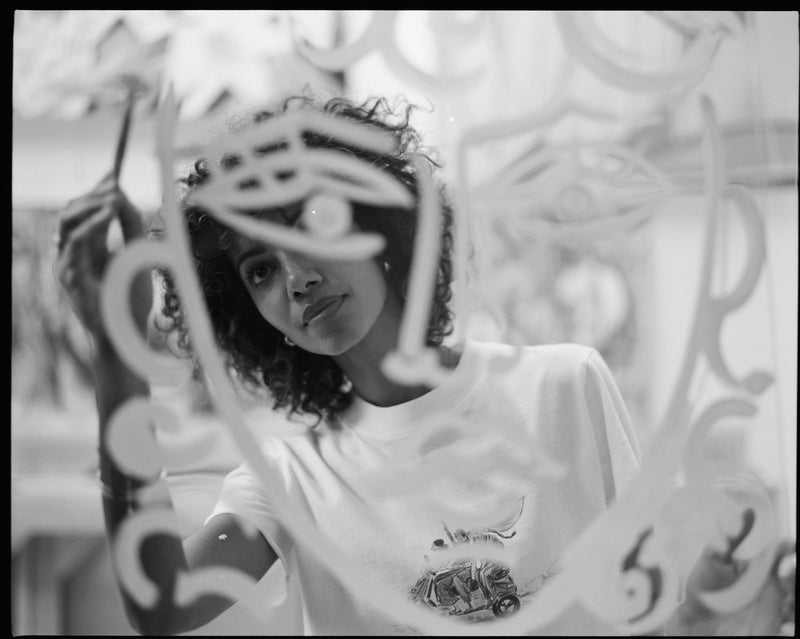
Krittika Mittal on sunlight, sourdough, and the weight of small things

We met Krittika Mittal by chance, the way a lot of the best things happen. We were pouring coffee tastings at Porter Flea, a Nashville pop-up full of independent makers and people wandering around looking for things they didn't know they needed yet.
Krittika was set up right next to us with her illustration brand, Artkrittique. Before long, Sean, Dani, Krittika, and her partner were deep in a conversation about coffee, art, and India. Sean was already deep into sourcing India-focused coffee for Volume 08, and Krittika had grown up in New Delhi. The connection felt too good not to follow.
By the end of the market, we'd swapped a Folk Volume for one of her prints, Journey to the Unknown: a lone traveler, map in hand, wrapped in dense leaves, bright color, and deep shadow. As Volume 08: Understory, came together around the forested coffee farms of India's Western Ghats, that print kept feeling more and more like the right fit. It's a landscape you have to step inside to actually understand.

Krittika's work has always lived in that space between the everyday and the enormous. A cup of coffee, a dog chasing a patch of sunlight, the color she can't stop reaching for. We wanted to know more about where that comes from, so we asked her.
Mornings, rituals, and what keeps her grounded
What does a really good morning look like for you?
A good morning starts with a great cup of coffee, eggs, and sourdough. I am trying my hardest to be more conscious about leaving my phone away when I wake up. It can be tough because I often wake up to messages and emails from people in India, which can lead to a stressful start to the day. If I can separate that from my morning routine, there is nothing like it. From there, if I can squeeze in just one of the three habits I want to do regularly — exercise, sketching, or meditation — it's perfect.
Is there something small you like to have around when you're working? Not because it's useful, but because it helps you settle in.
Hmmm, I have never really given this much thought until now. The closest thing would be my cup of coffee. I love to start my day with one, and then have another in the afternoon. In fact, I have a bit of a bad habit: my desk and bedside are always cluttered with coffee cups, glasses of water, or teacups.
What's something that never fails to bring you joy? Big or small, serious or silly.
Good chocolate! Nothing beats an 80% dark chocolate with nuts.
What songs or artists would be on the soundtrack to your life right now, or all-time?
I love Nazia Hassan, a Pakistani singer. She sang many disco songs in the 1980s, and they have a wonderful energy without feeling overwhelming — great tracks to listen to while settling into a routine. My favorites are "Boom Boom" and "Aap Jaisa Koi." I've been listening to her music a lot during my evening work sessions.

New Delhi, Baltimore, and the parts that travel with her
You grew up in New Delhi and now live in Baltimore. What would you say is "home" to you these days, geographically or otherwise?
Home is wherever I am at the moment. I've been living in my current apartment for three years, so it definitely feels like home. But India is where I grew up. Interestingly, whenever I travel, it only takes me a few hours to settle into a familiar routine and feel right at home, which often surprises me.
Are there parts of Indian daily life that you notice more clearly from a distance?
I think family and culture, definitely. Indian culture has an inherent warmth; there is a way of stepping up and helping each other out where asking for help never feels like a burden. At the same time, I am keenly aware of how toxic family dynamics can sometimes be.
Color also plays a huge role. India is just so incredibly colorful. I love buying clothes every time I go back because the designs are so intricate and beautiful. That is probably one of the strongest reasons I use so much color in my own work and am drawn to it. The funny part is that whenever I create black-and-white art now, people around me always say they can't wait to see it in color!
When South Asian details show up in your work, do you think of them as references, memories, design choices, or just part of the world you're drawing?
They are simply part of the world I am drawing. For example, when illustrating memories related to anger, I drew a scene based on packing a tiffin for my brother. When I showed the sketches to my teacher, I realized she had a hard time understanding what a tiffin was, or what it looked like, until I showed her photos. If you ask me to draw a lunchbox, I will always instinctively think of the classic tiffin box I grew up with. But if you ask me to draw trees, my references are now based on the trees around me in Baltimore. So, I guess the process is quite fluid.

The work, and what it's actually for
Your work often returns to everyday comforts: food, plants, pets, rooms, textiles, small objects. What keeps pulling you back to those details?
My practice revolves heavily around capturing moments of everyday happiness, and aren't those small details exactly what bring us joy? There is nothing quite like cooking your favorite food at home, or cuddling up with your dog. They are monotonous, routine moments, yet they bring a profound, quiet sense of peace.
You've said that everyday moments can hold massive emotions. What's an example of a small moment that still feels big to you?
Something as simple as sunlight filtering into a room can feel massive. It's a fleeting moment in time, but it makes me appreciate my life a bit more. The reflections make me think about the decor I've chosen for my apartment, or I'll watch my dog try to find that single ray of light to curl up in. Feeling grateful for that warmth during the winter. So many emotions can stem from a simple, everyday thing like the sun shining!
You've talked about once worrying that your work was just "Pinterest pretty." Do you still think there's a real difference between something being beautiful and something being meaningful, or was that part of the trap?
My biggest realization has been that both can coexist. The work with the potential to touch the most people lies right at that intersection, though it isn't necessarily the kind of work people want to hang in their homes. Furthermore, what brings me personal satisfaction doesn't always resonate with everyone else.
For a long time, my work focused on creating images that were purely aesthetically pleasing and accessible. I believed that by removing the friction of my personal life, I was creating a space where anyone could find rest. I still deeply value that work; it taught me the language of beauty and how to build a practice that welcomes an audience. However, my thesis challenged me to find a different narrative — one found in friction, not just rest. That work was deeply meaningful and led to me winning multiple awards.
There are advantages to creating both kinds of work, and reasons to create some. My thesis definitely helped me confront emotions my normal practice wouldn't, but my normal practice has led to work opportunities and collaborations I'm super proud of.
A lot of your images feel full, with pattern, color, furniture, and little details sharing the same space. How do you know when fullness feels alive instead of crowded?
I wish there were a mystical answer for this, but it just comes down to a lot of practice, making a high volume of work, and understanding my own aesthetic preferences. Observing how other artists and interior designers approach composition is also incredibly helpful.

On teaching, and the advice she still needs to hear
You teach an undergrad class on building a sketchbook practice. Why should someone keep a sketchbook?
To try out new things without fear. To have a dedicated space where you can make art solely for yourself. To train your brain and become more open to making "bad" work. To realize that drawing is a skill rather than an innate talent, and that you have to put the work in. To become more mindful. An illustration of a kettle I own today might be deeply meaningful to me a decade from now, reminding me of what I was obsessed with and what colors attracted me at this point in my life. We are our own greatest archives.
What's a piece of advice you give students that you still have to remind yourself of?
Success does not come overnight. It requires showing up and putting in the work repeatedly. There are lucky breaks here and there, but your work, your ethics, and your taste will keep defining your practice.
Explore more of Krittika's work at artkrittique.work or follow along @artkrittique. Her print, Journey to the Unknown, is featured in Volume 08: Understory.
Above the noise with Mokshini
Every Volume, Folk pairs two rare coffees with a piece of art that captures the same spirit as what's in...

Open air, open mind with Beth Hoeckel
There's something about Beth Hoeckel's work that stops you without warning. You're looking at what might be a sun-bleached travel...

The in-between with artist Ping Zhu
The first thing we noticed about Ping Zhu's work was how still it made us feel. That's not a small...