

Origins
Natural process coffee: why some coffees taste like fruit

The first sip is the giveaway. Maybe it’s blueberry, or black cherry, or something closer to strawberry jam than anything you'd expect from a morning cup. It's sweet in the way ripe fruit is sweet, and it has a weight to it that sits on your tongue a beat longer than usual.
Nobody added anything. No flavoring, no syrup, no clever trick at the roastery. That's just what a natural process coffee tastes like when it's made well, and it all comes down to one decision a farmer makes after harvest: leave the fruit on.
Natural process coffee (also called dry process or sun-dried) is coffee that's dried inside the whole cherry, fruit and all, before the seed is removed. Over two to four weeks of slow drying, the fruit's sugars and compounds work their way into the seed, which is why naturals tend to taste fruitier, sweeter, and fuller-bodied than washed coffees. It's the oldest way to process coffee, and one of the hardest to do really well.
That's the short version. Here's what's actually happening on the drying beds, why the name is a little misleading, and how to get the most out of one in your own cup.
What "natural" doesn't mean
It's an easy assumption: "natural" sounds like "organic," or "chemical-free," or somehow more wholesome than other coffees. It isn't any of those things, at least not by definition.
Every coffee is processed. As you know, coffee starts as a fruit, and before the seed inside can be roasted, it has to be separated from that fruit and dried. The choices a farm makes during that step are called processing. "Natural" is simply the name for one of those choices, the one where the fruit stays on for the entire drying period.
It's also not the same thing as natural wine, though if that's your world, you'll find plenty that feels familiar. More on that in a moment.
How natural process coffee is made
On paper, it sounds almost too simple. Pick the cherries. Lay them out in the sun. Wait. In practice, it's one of the most hands-on, attention-heavy jobs on a coffee farm.
Here's how it usually goes:
- Picking and sorting. Cherries are harvested at peak ripeness, then sorted to pull out anything underripe, overripe, or damaged. This step matters even more for naturals than for other methods, because every cherry stays in the fruit for weeks. One bad one can affect everything around it.
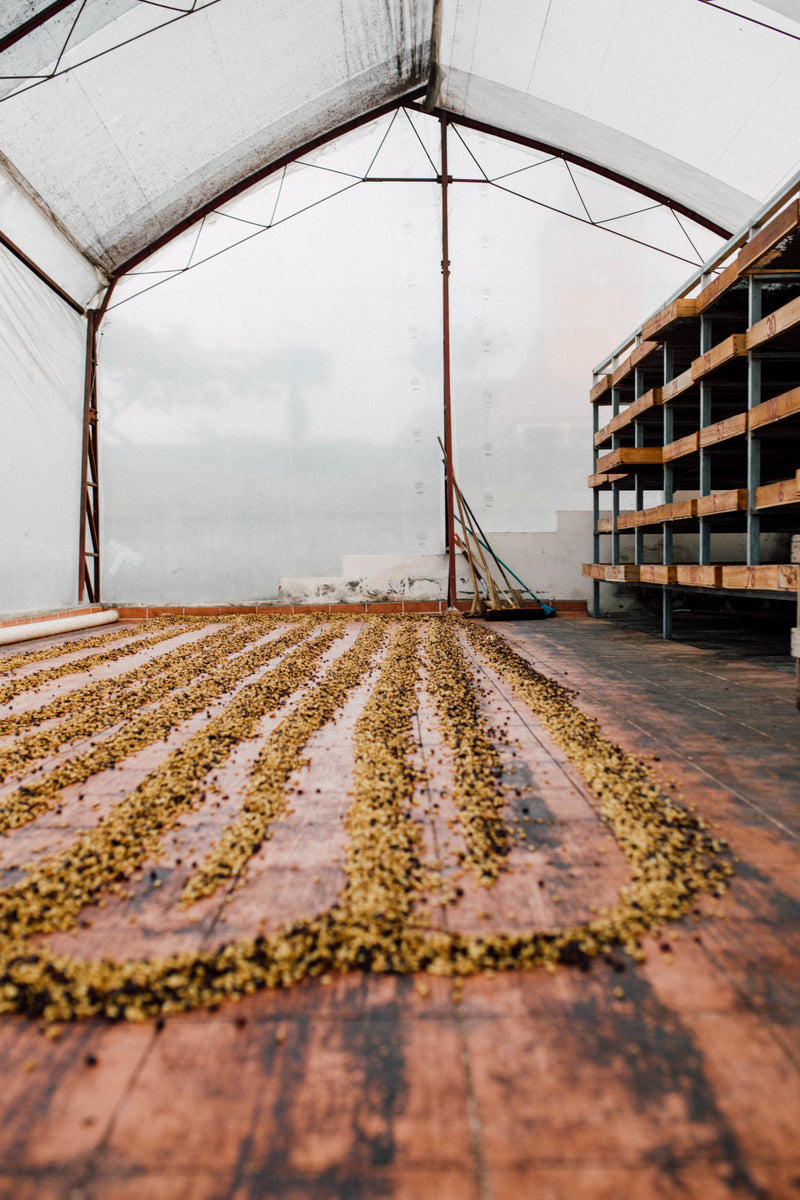
- Spreading out to dry. The whole cherries are spread in thin layers, either on patios or on raised beds (think long mesh tables at waist height). Raised beds let air move underneath, which helps the coffee dry more evenly.
- Turning, raking, and watching the weather. Early on, the cherries are turned every few hours so no side sits too long in the sun or in moisture. Producers track humidity and rain, covering the beds when the weather turns, and adjusting layer thickness as the fruit shrinks.
- Slow drying to around 11% moisture. Depending on climate, this takes anywhere from two to four weeks, sometimes longer. The target is roughly 11% moisture, which keeps the seed stable for storage and shipping.
- Hulling. Once dry, the cherry has shriveled into a dark, brittle husk (a lot like a raisin), and it's milled off to reveal the green coffee seed inside.
All that time in the fruit is the whole point. As the cherry dries, naturally occurring yeasts and bacteria break down the sugars in the fruit, and the seed soaks up the results. Sean Stewart, Folk's founder and a licensed Q Grader, describes it with an image anyone who's left a sliced apple on the counter will recognize: "Like when we bite an apple and it becomes brown, that's sugars developing."
Those developing sugars are what gives natural process coffees their extra sweetness and body. They also change how you perceive acidity. A natural doesn't actually have less acid than a washed coffee, but all that added sweetness and weight rounds it off, so it reads softer and less sharp.
The oldest method in coffee, and one that's still evolving
Natural processing predates running water, machinery, and just about every piece of equipment you'd find at a modern coffee mill. It's how coffee was first prepared in Ethiopia and Yemen, and those two places still produce some of the most celebrated naturals in the world. Brazil, the largest coffee producer on the planet, has relied on it for generations, largely because it's practical at scale and in drier climates.
It also uses far less water than washed processing, which makes it a sensible choice in regions where water is scarce.
And while natural processing had a reputation for being inconsistent and occasionally funky, the craft has changed.
Producers started using raised beds instead of bare ground, sorting more carefully, drying more slowly, and paying closer attention to how weather and airflow shaped the cup. Today, the best naturals are among the most sought-after coffees in the world, and plenty of producers use natural drying as the backbone for newer methods, like anaerobic naturals, where the cherries ferment in sealed tanks before they ever hit the drying beds.
Why natural process coffee is harder than it looks
Here's the part most articles skip: natural processing is a balancing act, and the margin for error is thin.
Fermentation is what makes a natural special. It's also what can ruin one. Too little control, and fermentation runs past sweet and fruity into vinegar, overripe fruit, or something closer to a compost pile. Dry too fast, and you lose the sweetness. Dry too slowly, or let the layers get too thick, and you risk mold. A sudden rainstorm in week two can undo everything.
That's why the best producers don't treat it as a "set it and forget it" method. They're out on the beds every day, turning the coffee, reading the weather, and deciding when to step in and when to leave it alone.
Take Efren Echeverri, a producer in Palestina, Huila, Colombia, whose Pink Bourbon natural appeared in Folk's Volume 05: Open Air. Efren studied fermentation science before returning to his family's farm at 1,800 meters, and what he came home with wasn't a taste for novelty. It was a focus on repeatability. He turns his coffee regularly, responds to shifts in weather and airflow, and otherwise lets the process move at its own pace. His approach is less about control than knowing when to intervene and when to wait.
When Sean evaluates any coffee with a lot of fermentation character, he's looking for exactly that restraint in the cup: "A little bit of funk is good, it can add complexity, but the finish has to be clean and sweet."
Natural vs. washed vs. honey: the quick comparison
If you want the full side-by-side, we've written a whole guide to washed, natural, and honey processing. The short version:

None of these is objectively better. As Sean puts it, "The process is changing the flavors always, no matter what it is." Washed coffee just changes them in the direction of clarity, while a natural leans toward sweetness and texture.
What natural process coffee tastes like
Sweetness and body are the throughline. Beyond that, a natural can go in a lot of directions.
The classics. Blueberry, strawberry jam, dried cherry, and a red-wine warmth are the notes you'll see on nearly every bag, and for good reason. They show up often, especially in Ethiopian naturals.
The less obvious ones. Well-made naturals can also land on cola, baking spice, dark chocolate, dried mango, papaya, or even something herbal. These are the notes that tend to surprise people, and they're often where the complexity lives.
Body. If you drink wine, you already understand body. It's the difference between a light Pinot Noir and a full Syrah, or between skim milk and whole milk. Naturals sit on the fuller end, often with a syrupy weight that coats your mouth rather than moving through it quickly.
The finish. Where a washed coffee often exits quickly and cleanly, a good natural leaves something behind: a lingering sweetness, a warmth that stays after you've swallowed.
A note for natural wine drinkers
If you love natural wine, naturals are a very good place to start with specialty coffee. They share a lot of the same appeal: expressive fruit, a little wildness around the edges, and flavors that feel alive rather than polished. They're not the same thing (natural wine is about minimal intervention in the cellar, natural coffee is about drying the fruit intact), but the same curiosity that makes you reach for a skin-contact white will serve you well here.
How to brew and taste a natural process coffee
You don't need special gear to enjoy a natural, but a few small choices help its sweetness and body come through.
A simple starting recipe:
- Use a 1:16 coffee-to-water ratio (30 grams of coffee to 480 grams of water). If you want to lean into the body, try 1:15.
- A flat-bottom pour-over or a steep-and-release brewer (like a Clever dripper) with a paper filter keeps the cup clean while still letting that syrupy texture through.
- Bloom with about twice the coffee's weight in water, wait 30 to 45 seconds, then add the rest.
Then give it five minutes. This is the single most useful tip for naturals. Freshly brewed coffee sits around 185°F, which is too hot for your palate to register much beyond heat. As it cools toward 135°F, sweetness comes forward, acidity softens, and the fruit starts separating into distinct notes. Naturals have more layers than most coffees, and those layers reveal themselves as the cup cools.
What to notice:
- Sweetness first. Where does it show up? Right away, in the middle of the sip, or at the end?
- Then body. Hold a sip on your tongue for a second. Is it light and quick, or does it coat your mouth?
- Then the finish. After you swallow, what stays? A good natural leaves something warm and rounded behind.
There's no right answer and nothing to get right. You're just noticing what's already in the cup.
Folk Volumes that feature natural process coffees
Natural process coffee, answered
What is natural process coffee?
It's coffee that's dried inside the whole cherry, fruit and all, before the seed is removed. The long drying time lets the fruit's sugars influence the seed, which gives naturals their fruity, sweet, full-bodied character.
Is natural process the same as dry process?
Yes. Natural, dry process, and sun-dried all refer to the same method: drying the coffee cherry whole, with the fruit still intact.
Why does natural process coffee taste fruity?
The seed spends weeks drying inside the cherry. As the fruit ferments and dries, its sugars and flavor compounds work their way into the seed, which shows up in the cup as notes like blueberry, cherry, or jam.
What's the difference between natural and washed coffee?
Washed coffee has its fruit removed before drying, which produces a lighter, brighter, cleaner cup. Natural coffee dries with the fruit on, which produces more sweetness, fuller body, and more fruit-forward flavor.
Is natural process coffee organic or healthier?
Not by definition. "Natural" describes how the coffee was dried, not how it was farmed. A natural process coffee can be certified organic, but the processing method itself doesn't make it so.
Does natural process coffee have more caffeine?
No. Processing affects flavor, not caffeine content in any meaningful way. Variety (Arabica vs. Robusta) and how you brew matter far more.
Why do some natural coffees taste funky or sour?
Usually because fermentation went too far during drying, from uneven drying, thick layers, bad weather, or damaged fruit. A well-made natural should taste sweet and clean on the finish, not boozy or vinegary.
Which countries are known for natural process coffee?
Ethiopia and Yemen, where the method originated, along with Brazil. Today you'll also find excellent naturals from Colombia, Rwanda, Costa Rica, Panama, and many other origins.
What's the best way to brew natural process coffee?
A paper-filtered pour-over or immersion brewer at around a 1:16 ratio is a great start. Most importantly, let it cool for about five minutes before tasting, since naturals open up as the temperature drops.
Naturals are one of those things that make a lot more sense with a cup in your hand. Every month, Folk sends two rare, Q-Grader-selected coffees scoring 86+, each Volume built around one story, whether it's a region, a process, or a flavor. Explore this month's Volume, or read our side-by-side guide to washed vs. natural vs. honey coffee for the bigger picture.
Women in coffee: The history, the gap, and the Burundi women closing it
In Burundi's northern hills, a coffee harvest has traditionally ended the same way. Women pick the cherries, sort them, and...
Honey processed coffee: the sweet spot between washed and natural
Read the label on a bag of "red honey" or "black honey" coffee for the first time and it's a...
El Salvador: The origin that bred its own varietals
El Salvador's coffee story restarts in 2002, with a homecoming. Aida Batlle was 28 when she came back to take...